Posts

SSHRC Storyteller Initiative

The Social Sciences and Humanities Research Council of Canada is sponsoring a student presentation initiative of what makes the humanities and social sciences great. Students can make a three minute video or other social media presentation and compete Canada-wide for 25 finalist spots. More information below: SSHRC launches student contest to promote liberal arts research   The Social Sciences and Humanities Research Council (SSHRC) has launched a contest that challenges PSE (post-secondary) students to show Canadians how liberal arts research is “affecting our lives, our world and our future prosperity.” SSHRC is accepting submissions from November 1 to January 15 in the form of a 3-minute pitch via podcast, op-ed, video, or infographic. The top 25 finalists will receive registration and accommodation at SSHRC’s Congress 2014 conference in May, at which they will promote their project and participate in a research communications workshop. 5 jury-chosen presenters will the...

Wycliffe Centre for Scripture and Theology Fall Colloquium 2013 - Reading Paul

Wycliffe Centre for Scripture and Theology Fall Colloquium 2013 announced . It is a geat line-up on "Reading Paul: Exegetical Method and Interpretation after the 'New Perspectives.'" ............................................................................................................................................................ Reading Paul: Exegetical Method and Interpretation After the "New Perspectives" Presentations by Dr. Ian W. Scott   (Tyndale) "Overview of the 'New Perspectives'" Author of Paul's Way of Knowing: Story, Experience, and Spirit. Baker, 2008. 9:15am Dr. Douglas Harink   (King's College) "Prolegomena to an Imagined Project: Systematic Theology as a Commentary on Romans" Author of 1 & 2 Peter. Brazos Theological Commentary on the Bible. Brazos, 2009; Paul among the Postliberals:...

Community, Vocation, Virtue, and Classic Education as Benefits of Religious Higher Education

Dr. Thomas Albert Howard of Gordon College in Wenham, Mass recently wrote a article for Inside Higher Ed entitled "The Promise of Religious Colleges."  Howard argues that the current challenges facing higher education actually offer religious institutions of higher education "a propitious opportunity." The positives as he states them are, first, that religious institutions are still about the personal, about the interaction between faculty and students not just in the classroom but also, and almost more importantly, outside the classroom. The discussion of things that matter and the mentoring that occurs at these institutions is something that cannot be offered in the same way or at all at larger universities. Second, codes of conduct still exist are religious institutions and need not seem antiquated. Third, these universities and colleges focus on vocation and calling and not career. The religious institutions challenge students to shape their lives and fu...

Visualized Bible: Cross-references Imaged

Image
Recently the Guardian Data Blog brought together a number of data images of the Bible in a post entitled "Holy Infographics: the Bible Visualised." The above image is the first of those images. I think that the image itself is actually quite beautiful in the rainbow like arcing of color, especially when the high resolution image is viewed (find that here ). The image is attributed to Christoph Römhild and Chris Harrison. And the following description of the image is given:   "This is about how the bible speaks to itself - or the textual cross-references within it. The bar graph that runs along the bottom represents all of the chapters in the Bible. Books alternate between white and light gray and the length of each bar denotes the number of verses in the chapter. Each of the 63,779 cross references found in the Bible is depicted by a single arc - the color corresponds to the distance between the two chapters, creating a rainbow-like effect." This ap...

GK Chesterton on Distraction and Multi-tasking

In his short essay "On the Prison of Jazz" published in Selected Essays (Collins, 1939), G.K. Chesterton makes some comments entirely relevant to multi-tasking and distraction. His primary topic is the inability to hold a conversation in a restaurant while there is live music, namely jazz: "But talking to people who are listening to something else which is not the talk is a sort of complex or nexus of futility." Considering he lived in a non-digital age, his comments on distraction and doing two things at once are strikingly and even more worthy of consideration. "For, though we talk lightly of doing this or that to distract the mind, it remains really as well as verbally true that to be distracted it to be distraught. The original Latin word does not mean relaxation; it means being torn asunder as by wild horses. The original Greek word, which corresponds to it, is used in the text which says that Judas burst asunder in the midst. To think of one thing at a...

The Bible Miniseries 3: Weakest Moments and the Most Powerful One

Image
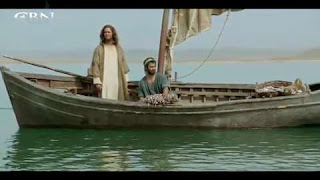
Previously, I have commented on the  "10 hour" miniseries on "The Bible" with regard to its portrayal of angels and its portrayal of certain characters such as John the Baptist. I would like to conclude my three part series by addressing what to me were two of the weakest moments of "The Bible" from a biblical and theological perspective. To be fair I will finish with a few comments on what I think is the most powerful scene of the 10 hours. (Comments on this scene have already been made by Rachel McMillan .) The first of the two weak moments I want to mention is the calling of Peter . This scene has problems for me because there is a cheesiness to it, while it is also a bit off both biblically and theologically. This account of the calling of Peter comes from Luke 5 and not from Matthew or Mark or John. In Luke's account, Peter, James, and John become disciples after Jesus gets into Simon Peter's boat and asks Peter to take him out into the ...

The Bible Miniseries 2: Interpretation through Characters and Juxtapositions

Continuing with some thoughts and reflections on the "10 hour" miniseries on  The Bible , I want to follow up my comments on the portrayal of angels with some comments on certain characters and the depictions of them. The first I would like to mention is that of John the Baptist. John the Baptist is an extremely important figure in the Gospels. All four Gospels present John as the forerunner of Jesus the Messiah. He is the one who prepares the way, fulfilling prophecies from Malachi 3 and Isaiah 40. Although Luke says that John and Jesus are related, none of the other three Gospels indicate any special relationship between John and Jesus apart from John's baptism of Jesus. "The Bible" portrays John as the sort of eccentric holy man or prophet that he most likely was. John the Baptist led a renewal movement for the forgiveness of sins out in the wilderness in the provocative location of Israel's entry into the promised land (Joshua 3). What I found comp...