Posts

The Bible Miniseries 3: Weakest Moments and the Most Powerful One
Image
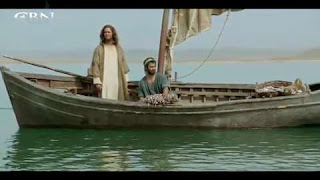
Previously, I have commented on the  "10 hour" miniseries on "The Bible" with regard to its portrayal of angels and its portrayal of certain characters such as John the Baptist. I would like to conclude my three part series by addressing what to me were two of the weakest moments of "The Bible" from a biblical and theological perspective. To be fair I will finish with a few comments on what I think is the most powerful scene of the 10 hours. (Comments on this scene have already been made by Rachel McMillan .) The first of the two weak moments I want to mention is the calling of Peter . This scene has problems for me because there is a cheesiness to it, while it is also a bit off both biblically and theologically. This account of the calling of Peter comes from Luke 5 and not from Matthew or Mark or John. In Luke's account, Peter, James, and John become disciples after Jesus gets into Simon Peter's boat and asks Peter to take him out into the ...

The Bible Miniseries 2: Interpretation through Characters and Juxtapositions

Continuing with some thoughts and reflections on the "10 hour" miniseries on  The Bible , I want to follow up my comments on the portrayal of angels with some comments on certain characters and the depictions of them. The first I would like to mention is that of John the Baptist. John the Baptist is an extremely important figure in the Gospels. All four Gospels present John as the forerunner of Jesus the Messiah. He is the one who prepares the way, fulfilling prophecies from Malachi 3 and Isaiah 40. Although Luke says that John and Jesus are related, none of the other three Gospels indicate any special relationship between John and Jesus apart from John's baptism of Jesus. "The Bible" portrays John as the sort of eccentric holy man or prophet that he most likely was. John the Baptist led a renewal movement for the forgiveness of sins out in the wilderness in the provocative location of Israel's entry into the promised land (Joshua 3). What I found comp...

The Bible Miniseries: Angels

Not long ago now, I watched the "10 hour" miniseries on The Bible . Thankfully I didn't have to sit through the almost three hours of commercials to do so. And once you figure in all of the repetitive "previously on 'The Bible'" bits, it may only be 6+ hours. Regardless of its length, The Bible was an ambitious project that was well received, and it will probably continue to be well received. However, any project of this size and breadth will have its positive and negative aspects. Thankfully, the miniseries was more positive than negative. They made some interesting choices on what to film, and stories were woven together in thought provoking ways that brought about fresh interpretation. Yet there were other instances where the scene or script fell flat in dramatically disappointing ways. One aspect that I was most impressed with was the portrayal of the angels. I have done some research on angels in Second Temple Judaism, and the portrayal of ange...

Robert H. Gundry on "Learning for Spirituality"

Here is a brief excerpt from Robert H. Gundry's essay "Learning for Spirituality" which is in his new book Extracurriculars: Teaching Christianly Outside Class. It was originally an address given in chapel at Westmont College where Gundry is Professor Emeritus and Scholar-in-Residence. "...my point...is not to work Christianity into your business. It's not to work spirituality into your learning. You should, of course. You should make your learning an act of worship by putting a Christian perspective on the literature you study, on the art, on the psychology, on the sociology, the political science--on whatever you study. Sometimes it'll be easy to do, sometimes hard to do. How do you put a Christian perspective on math? I don't know. Maybe our math teachers can tell us. But this morning isn't about putting learning into spirituality, about infusing our learning with spirituality. It's the other way around. It's about putting learning into ...

The Liberal Arts in Washington State

James McGrath just tweeted a link to this article by Michael Zimmerman at the Huffington Post . It is a great piece on the value of the liberal arts, and it highlights how employers actually want exactly what liberal arts grads have to offer. The exerpt from the winner of the student essay...superb! This is why I teach undergraduates at a liberal arts institution. This is why I believe the liberal arts is the best education on offer. Anyone for a Canadian Consortium for the Liberal Arts? I am all for it.

Mark Sargent on the Value of the Christian Liberal Arts

Mark Sargent has been provost at Westmont College now for over a year. The following is a long excerpt on the value of Christian Liberal Arts Education from an article in the Westmont Magazine entitled "A Few Words from Mark Sargent" (Winter 2012). They are great words and reminders about what the liberal arts is and how important this sort of education has been and will continue to be. The Value of Christian Liberal Arts Education During my college years I often made long bicycle trips with friends along the California coast. For cyclists, few stretches of the road are more demanding than the Big Sur coastline, where the mountains press against the sea. For 70 miles the highway clings to precipitous cliffs, mixing sharp climbs and rapid descents. That stage of the journey requires full concentration on the thin white line along the road’s edge as you weave through the fallen shale and pine branches and avoid nervous drivers.Yet every now and then, after a long ...

Translating the Bible and First Nations Languages

I sat in on Ruth Heeg's paper at the Native American Institute of Indigenous Theological Studies Symposium 2013 Friday afternoon. The paper was quite interesting, especially for someone who teaches Greek and challenges students to think about translation. Some sitting near me were less than enthused about the discussion of transitive and intransitive verbs and abstract nouns in Greek, English, and Algonquian languages. At some level, (μεν) I agree with them, but (δε) on the other hand, all of these grammatical details are important for translation, especially when it involves translating a text that means a lot to many people. In her paper, Heeg focused on the translation of Greek abstract nouns in First Nations languages, particularly Algonquian languages such as James Bay Cree, Ojibwe, and Plains Cree, in New Testament doxologies. One passage she used as an example was Rev 4:11: “Worthy art thou, our Lord and God, to receive glory and honor and power, for thou didst create a...