Posts

Showing posts with the label media

Thoughts on "Jesus Christ didn't exist"

Image
The Daily Mail Online has run a piece today entitled: "' Jesus NEVER existed': Writer finds no mention of Christ in 126 historical texts and says he was a 'mythical character .'" The writer is Michael Paulkovich who is described as a "historical researcher." (It is probably worth mentioning that the next story that the Daily Mail suggests its readers view is "Has 'Dracula's dungeon' been unearthed in Turkey?") As the title, and every following paragraph, states, Paulkovich did not find reference to Jesus in 126 ancient historical writers (his list is provided), and so therefore, Paulkovich believes Jesus was mythical. The assumption built in here is that by the end of the first century Jesus was famous enough throughout the Roman Empire that any decent historian would have mentioned him: "all of whom should have heard of Jesus but did not."  Yet, it should be obvious that this is clearly an argument from sile...

Son of God: The Bible Miniseries Remix

There has been a bit of talk with the release of "Son of God" in the theatres within the last two weeks. I have not seen it, but I have seen the full Bible miniseries from which "Son of God" is derived. Through various reviews, I have learned that material was edited out and deleted scenes added. So it would have been worth my time to view the "new" film as a study in modern Gospel redaction. Craig Keener's article in CT highlights the removal of the devil from the "Son of God." I suspect this means that the entire temptation narrative was excised. Keener's article is also provides an in-depth look at the role the devil plays in each of the Gospel narratives. So his review is not so much a review as an excellent mini-study on the devil in Matthew, Mark, Luke, and John. Kenneth R. Morefield in a CT movie review refers to the "Son of God" as "a bit like listening to a pretty good tribute band doing a set list of Top 40...

Surprise! Texting and Web Surfing Affects Learning

Here is the concluding quote from a recent study by Kuznekoff and Titsworth on the use of texting and social media posts by students in the classroom: ". . . students who use their mobile phones during class lectures tend to write down less information, recall less information, and perform worse on a multiple-choice test than those students who abstain from using their mobile phones during class." Cited from,  J. H. Kuznekoff and S. Titsworth,"The Impact of Mobile Phone Usage on Student Learning." Communication Education, 62.3 (2013): 233-252 at 251. Not any surprise here. This is also why texting and driving are illegal in most places. Some further illuminating quotes from the study are as follows: "The practical implication stemming from the tests surrounding hypothesis 2 is that students who were actively texting/posting simply recalled less information than students who were not texting/posting. Specifically, students in the control group...

SSHRC Storyteller Initiative

The Social Sciences and Humanities Research Council of Canada is sponsoring a student presentation initiative of what makes the humanities and social sciences great. Students can make a three minute video or other social media presentation and compete Canada-wide for 25 finalist spots. More information below: SSHRC launches student contest to promote liberal arts research   The Social Sciences and Humanities Research Council (SSHRC) has launched a contest that challenges PSE (post-secondary) students to show Canadians how liberal arts research is “affecting our lives, our world and our future prosperity.” SSHRC is accepting submissions from November 1 to January 15 in the form of a 3-minute pitch via podcast, op-ed, video, or infographic. The top 25 finalists will receive registration and accommodation at SSHRC’s Congress 2014 conference in May, at which they will promote their project and participate in a research communications workshop. 5 jury-chosen presenters will the...

Visualized Bible: Cross-references Imaged

Image
Recently the Guardian Data Blog brought together a number of data images of the Bible in a post entitled "Holy Infographics: the Bible Visualised." The above image is the first of those images. I think that the image itself is actually quite beautiful in the rainbow like arcing of color, especially when the high resolution image is viewed (find that here ). The image is attributed to Christoph Römhild and Chris Harrison. And the following description of the image is given:   "This is about how the bible speaks to itself - or the textual cross-references within it. The bar graph that runs along the bottom represents all of the chapters in the Bible. Books alternate between white and light gray and the length of each bar denotes the number of verses in the chapter. Each of the 63,779 cross references found in the Bible is depicted by a single arc - the color corresponds to the distance between the two chapters, creating a rainbow-like effect." This ap...

GK Chesterton on Distraction and Multi-tasking

In his short essay "On the Prison of Jazz" published in Selected Essays (Collins, 1939), G.K. Chesterton makes some comments entirely relevant to multi-tasking and distraction. His primary topic is the inability to hold a conversation in a restaurant while there is live music, namely jazz: "But talking to people who are listening to something else which is not the talk is a sort of complex or nexus of futility." Considering he lived in a non-digital age, his comments on distraction and doing two things at once are strikingly and even more worthy of consideration. "For, though we talk lightly of doing this or that to distract the mind, it remains really as well as verbally true that to be distracted it to be distraught. The original Latin word does not mean relaxation; it means being torn asunder as by wild horses. The original Greek word, which corresponds to it, is used in the text which says that Judas burst asunder in the midst. To think of one thing at a...

The Bible Miniseries 3: Weakest Moments and the Most Powerful One

Image
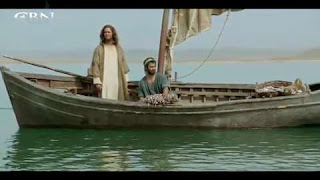
Previously, I have commented on the  "10 hour" miniseries on "The Bible" with regard to its portrayal of angels and its portrayal of certain characters such as John the Baptist. I would like to conclude my three part series by addressing what to me were two of the weakest moments of "The Bible" from a biblical and theological perspective. To be fair I will finish with a few comments on what I think is the most powerful scene of the 10 hours. (Comments on this scene have already been made by Rachel McMillan .) The first of the two weak moments I want to mention is the calling of Peter . This scene has problems for me because there is a cheesiness to it, while it is also a bit off both biblically and theologically. This account of the calling of Peter comes from Luke 5 and not from Matthew or Mark or John. In Luke's account, Peter, James, and John become disciples after Jesus gets into Simon Peter's boat and asks Peter to take him out into the ...

The Bible Miniseries 2: Interpretation through Characters and Juxtapositions

Continuing with some thoughts and reflections on the "10 hour" miniseries on  The Bible , I want to follow up my comments on the portrayal of angels with some comments on certain characters and the depictions of them. The first I would like to mention is that of John the Baptist. John the Baptist is an extremely important figure in the Gospels. All four Gospels present John as the forerunner of Jesus the Messiah. He is the one who prepares the way, fulfilling prophecies from Malachi 3 and Isaiah 40. Although Luke says that John and Jesus are related, none of the other three Gospels indicate any special relationship between John and Jesus apart from John's baptism of Jesus. "The Bible" portrays John as the sort of eccentric holy man or prophet that he most likely was. John the Baptist led a renewal movement for the forgiveness of sins out in the wilderness in the provocative location of Israel's entry into the promised land (Joshua 3). What I found comp...

The Bible Miniseries: Angels

Not long ago now, I watched the "10 hour" miniseries on The Bible . Thankfully I didn't have to sit through the almost three hours of commercials to do so. And once you figure in all of the repetitive "previously on 'The Bible'" bits, it may only be 6+ hours. Regardless of its length, The Bible was an ambitious project that was well received, and it will probably continue to be well received. However, any project of this size and breadth will have its positive and negative aspects. Thankfully, the miniseries was more positive than negative. They made some interesting choices on what to film, and stories were woven together in thought provoking ways that brought about fresh interpretation. Yet there were other instances where the scene or script fell flat in dramatically disappointing ways. One aspect that I was most impressed with was the portrayal of the angels. I have done some research on angels in Second Temple Judaism, and the portrayal of ange...