Posts

Showing posts with the label Jesus

Thoughts on "Jesus Christ didn't exist"

Image
The Daily Mail Online has run a piece today entitled: "' Jesus NEVER existed': Writer finds no mention of Christ in 126 historical texts and says he was a 'mythical character .'" The writer is Michael Paulkovich who is described as a "historical researcher." (It is probably worth mentioning that the next story that the Daily Mail suggests its readers view is "Has 'Dracula's dungeon' been unearthed in Turkey?") As the title, and every following paragraph, states, Paulkovich did not find reference to Jesus in 126 ancient historical writers (his list is provided), and so therefore, Paulkovich believes Jesus was mythical. The assumption built in here is that by the end of the first century Jesus was famous enough throughout the Roman Empire that any decent historian would have mentioned him: "all of whom should have heard of Jesus but did not."  Yet, it should be obvious that this is clearly an argument from sile...
Image
King's College, London is hosting a conference June 20-22 on Jesus and Brian, the Life of Brian that is. The programme and other information can be found here . The mystery guest at dinner on 21 June might be worth attending! Chris Keith at the Jesus blog suggests one of the Pythons. Oh, another instance of wishing I was closer to London.

The Bible Miniseries 3: Weakest Moments and the Most Powerful One

Image
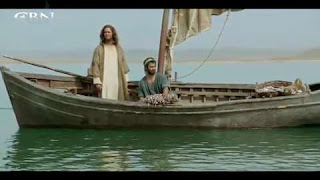
Previously, I have commented on the  "10 hour" miniseries on "The Bible" with regard to its portrayal of angels and its portrayal of certain characters such as John the Baptist. I would like to conclude my three part series by addressing what to me were two of the weakest moments of "The Bible" from a biblical and theological perspective. To be fair I will finish with a few comments on what I think is the most powerful scene of the 10 hours. (Comments on this scene have already been made by Rachel McMillan .) The first of the two weak moments I want to mention is the calling of Peter . This scene has problems for me because there is a cheesiness to it, while it is also a bit off both biblically and theologically. This account of the calling of Peter comes from Luke 5 and not from Matthew or Mark or John. In Luke's account, Peter, James, and John become disciples after Jesus gets into Simon Peter's boat and asks Peter to take him out into the ...

The Bible Miniseries: Angels

Not long ago now, I watched the "10 hour" miniseries on The Bible . Thankfully I didn't have to sit through the almost three hours of commercials to do so. And once you figure in all of the repetitive "previously on 'The Bible'" bits, it may only be 6+ hours. Regardless of its length, The Bible was an ambitious project that was well received, and it will probably continue to be well received. However, any project of this size and breadth will have its positive and negative aspects. Thankfully, the miniseries was more positive than negative. They made some interesting choices on what to film, and stories were woven together in thought provoking ways that brought about fresh interpretation. Yet there were other instances where the scene or script fell flat in dramatically disappointing ways. One aspect that I was most impressed with was the portrayal of the angels. I have done some research on angels in Second Temple Judaism, and the portrayal of ange...

Release of "A New New Testament"

I recently received an email from Houghton Mifflin Harcourt publishers about the release of a book edited by Hal Taussig called A New New Testament: A Bible for the 21st Century Combining Traditional and Newly Discovered Texts . The book is the traditional or canonical New Testament with the addition of ten texts that have been found in Egypt and elsewhere over the last one hundred years. The Gospel of Thomas and the Gospel of Mary are two of these texts. Hal Taussig is a founding member of the Jesus Seminar, and he gathered "a council of scholars and spiritual leaders" to talk about the various apocryphal New Testament texts and to vote about which ones to include in the New New Testament. I could only find the list of council members on the short video on the website. Some of this group include Karen King, Stephen Moore, and John Dominic Crossan. The case made in the promotional material is that these ten texts are early Christian literature and some of it "has be...

Gundry on Christ and Scripture

Image
Just a couple quotes from Robert H. Gundry's essay "Hermeneutic Liberty, Theological Diversity, and Historical Occasionalism in the Biblical Canon" in his book The Old is Better: New Testament Essays in Support of Traditional Interpretations (pp. 1-17). "...the Christ of the NT insists on questioning us before answering us. Here as elsewhere in the Bible the text interprets us before we interpret it" (15). "...it is not enough to know what the Scriptures teach; we also need to discern what is appropriate and inappropriate to be said from them in any given situation" (16).

Mark Noll on Learning and Jesus

Image
"...the greatest hope for Christian learning in our age, or in any age, lies not primarily in heightened activity, in better funding, or in strategizing for the tasks at hand--though all these matters play an important part. Rather, the great hope for Christian learning is to delve deeper into the Christian faith itself. And going deeper into the Christian faith means, in the end, learning more of Jesus Christ."  Mark A. Noll, Jesus Christ and the Life of the Mind,  22.

"The Gospel of Jesus' Wife"

News just broke Tuesday in the New York Times on the appearance of an ancient papyrus that speaks about Jesus as possibly having a wife. The papyrus has been dated to the fourth century. Karen King who has presented the only known information about the fragment has pointed out that it may have been composed in the second century. According to Christian Askeland , the majority of Coptologists (the fragment is written in Coptic) seem to think at this time that the document is a forgery (see also the comments to Christian's post). See further information here , including comments from Simon Gathercole who is a specialist on apocryphal gospels. A high resolution image and a translation of the document may be found in the NY Times article.

Von Balthasar on Prayer

Image
The following selection is from Hans Urs von Balthasar's preface in his book Prayer. The book, so far, is excellent. "Anyone entering the sphere of radiance of the divine word is held fast by it; he knows from experience that this word not only communicates knowledge about God, but--hidden within the garb of the letter--actually has divine qualities: in itself it is an overpowering manifestation of God's infinity and truth, his majesty and love. God's epiphany compels the hearer to kneel in humble submission. The latter had imagined that he was dealing with a word he could grasp and evaluate, like other great and profound utterances of mankind; yet once he enters its field of force, he himself is the one who is grasped and evaluated. He had wanted to approach Jesus in order to see him ("Come and see!"), and now, under the gaze of Jesus, he finds that it is he who has long been observed, seen through, judged and accepted in grace by Jesus. All he can do now...

John Webster, Christology, Exegesis and Theology

Image
An additional quote from John Webster's conclusion to his essay "Jesus Christ" in the Cambridge Companion to Evangelical Theology... "Christology responds to the self-communicative presence of its object in the twofold work of exegesis and dogmatics. Exegesis is not the same as study of the history of biblical literature and religion in their settings. Modern evangelicals have sometimes been bedazzled by the range and sophistication of historical procedures at their disposal, and busied themselves to master them in the hope of outbidding their opponents. But historical studies are the servant of exegesis, not its master. One thing which evangelical doctrines of the sufficiency of Scripture ought to have secured is that the ultimate resource is the text, not what can be reconstructed about what lies behind the text, for the text is an act of God's self-disclosure. The fruits of the immense labors of evangelical New Testament scholars are by no means negligibl...

John Webster, Jesus Christ, & Evangelical Theology

Image
Continuing through The Cambridge Companion to Evangelical Theology (ed. Timothy Larsen and Daniel J. Treier), John Webster presents a dense and sharp critique of evangelical theology on Christology in his essay "Jesus Christ." Any evangelical theology of Jesus or even NT study of Jesus should take into account Webster's challenges. Here are two such comments: "Contemporary evangelical historians of Jesus and his early followers are certainly more sophisticated then their forbears, and a good deal more relaxed about the need to defend the viability of confessional orthodoxy or the reliability and authority of the apostolic witnesses. What they have in common with earlier work is the fact that their arguments are historical, not theological, and direct themselves primarily to historical reason rather than the judgment of faith. In this sense, they continue the evangelical tradition of Christology "from below" -- not in the sense of proposing a "lo...

Wycliffe Centre for Scripture and Theology

Image
This Friday, 18 May 2012, Wycliffe College at the University of Toronto will be hosting the spring colloquium of the Wycliffe Centre for Scripture and Theology. The discussion and papers will be on Pope Benedict XVI's two volume work on Jesus. More details can be found here . "Engaging and Evaluating Benedict XVI’s Jesus of Nazareth" Pope Benedict XIV’s two-part volume on Jesus, which traces his life “historically” even as it describes him theologically and in a way that is congruent with traditional Catholic dogma, has proven both an extraordinarily popular work and one that has challenged biblical scholars in various critical ways. Several Protestant scholars here work with Benedict’s second volume (“Holy Week”) and discuss it with a Catholic theologian. Presentations by: David Trobisch (Nussloch/Springfield, MI ) Terence L. Donaldson (Wycliffe College, Toronto ) Joseph Mangina (Wycliffe College, Toronto )...

Jesus T-Shirts, Hate Speech and Religious Freedom

Image
Photo by Ryan Taplin, National Post Some interesting pieces at the National Post on the Nova Scotia high-schooler, William Swinimer, who has been repeatedly suspended for wearing a t-shirt with the slogan "Life is Wasted...Without Jesus." http://life.nationalpost.com/2012/05/03/suspended-nova-scotia-student-defiantly-wears-t-shirt-with-pro-jesus-message/ http://fullcomment.nationalpost.com/2012/05/04/marni-soupcoff-what-kind-of-lesson-is-a-school-teaching-by-banning-a-jesus-t-shirt/

Interview with Simon Gathercole at Tyndale University College

Dr. Simon Gathercole was recently at Tyndale for two lectures (Nov 17). There was great turn out for both, and we were treated to two stimulating lectures on substitution and the Gnostics, respectively. Simon was interviewed while he was here, and the Communications department has just posted this video.  Simon Gathercole Lectures at Tyndale Tyndale University College on Vimeo .

The Pope on Jesus, a review in First Things

Image
The October edition of First Things , which I have just had a chance to look through, has a review of Pope Benedict XVI's second volume of Jesus of Nazareth ( "Reading the Gospels with Benedict XVI" , pp. 35-40).   The review by Bruce Marshall is a good read, especially given that I do want to read Ratzinger's work on Jesus. There are a number of things about the review that could be mentioned, but I do want to note a discussion that comes toward the end of the review about the relationship between Biblical Studies and Theology. What sparks these comments by Marshall is the "frosty reception" that the he says the pope's book has been given by biblical scholars. He states that among other things: "...the book was dismissed as a misbegotten hybrid of critical scholarship and Catholic devotion..." (p. 39). And yes, that would cause some problems for the more historical-critically minded biblical scholar. Marshall continues, "Undeterred by...

The Calming of the Wind and the Waves

Image
In preparation for a lecture on Jesus' mighty works, I ran across this powerful painting and an artist I was not previously aware of. James Ensor, Le Christ apaisant la temp ê te, 1891. A link to the painting may be found here .

Albert Einstein on Jesus

Image
I ran across this interesting quote of a quote of a quote in James H. Charlesworth's, The Historical Jesus An Essential Guide (Abingdon, 2008), p. 8. "Einstein is often not mentioned in the list of Jews who admired the historical Jesus. In Einstein and Religion , Max Jammer quotes an interview with Einstein in 1929; here are Einstein's words: 'I am a Jew, but I am enthralled by the luminous figure of the Nazarene....No one can read the Gospels without feeling the actual presence of Jesus. His personality pulsates in every word. No myth is filled with such life' (p. 2)."

Goodacre on the Son of Man

Image
Mark Goodacre posted a podcast entitled "Who is this 'Son of Man'?" over at NT Pod in early April. I have finally had time to listen to it, and as usual, he has done an excellent job introducing a NT topic (which is why I continue to make use of his podcasts in class). Goodacre points out that "the Son of Man" ( ὁ υἱὸς τοῦ ἀνθρώπου ) was only spoken by Jesus and it is almost non-existent outside of the Gospels. So what did the phrase mean to Jesus? what did it mean to his followers? and why did early Christians essentially not use it? Such questions are why there is no end to scholarly discussion on the topic. I recognize that Goodacre is only giving an 11 minute introduction to a complex topic, but I did want to clarify a couple points. The Jewish Second Temple text the Similitudes of Enoch does make reference to a son of man figure and there are clear indications that Daniel 7 has influenced this text (chs. 46-48). Although Goodacre states that Similitu...